Dr. Felice Schnoll-Sussman, Highlights K-CAB’s U.S. Market Potential at KDDW 2025
HK inno.N Invites Key Investigator of K-CAB U.S. Clinical Trials to Highlight Market Potential at KDDW 2025
Dr. Felice Schnoll-Sussman, lead investigator of K-CAB’s U.S. clinical trials, presents comparative clinical data on P-CAB therapies at KDDW 2025.
Dr. Schnoll-Sussman: “K-CAB’s rapid onset of action within one hour and its flexibility to be taken regardless of meals will be key advantages in the U.S. prescription market.”
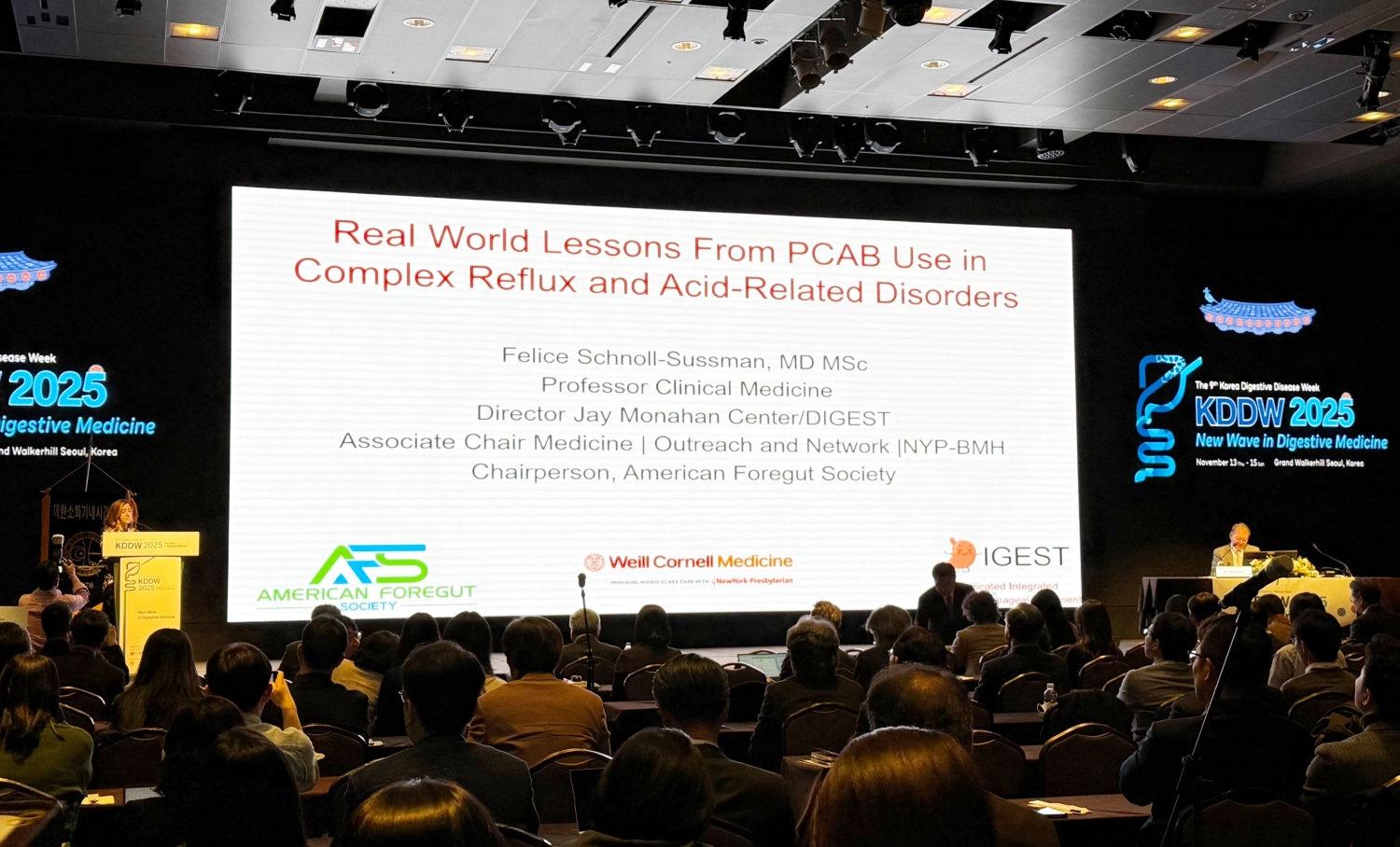
Photo. Dr. Felice Schnoll-Sussman, the lead investigator of K-CAB’s U.S. clinical trials, delivering a lecture at KDDW 2025.
HK inno.N announced on the 27th that Dr. Felice Schnoll-Sussman, the lead investigator of the U.S. Phase 3 clinical trials for its gastroesophageal reflux disease (GERD) treatment, K-CAB (active ingredient: tegoprazan), was invited to speak at the 9th Korea Digestive Disease Week (KDDW 2025). During the event, Dr. Schnoll-Sussman delivered a lecture on the clinical data of K-CAB, a novel P-CAB (Potassium-Competitive Acid Blocker) therapy.
Held from November 13 to 15 at the Grand Walkerhill Hotel in Seoul, KDDW 2025 brought together over 2,000 researchers from Korea and abroad to share the latest insights into digestive diseases. Dr. Schnoll-Sussman, a Clinical Professor of Medicine at Weill Cornell Medical College and Director of the Jay Monahan Center for Gastrointestinal Health, served as a keynote speaker during the session. Dr. Soo-Heon Park, a professor of gastroenterology at the Catholic University of Korea’s Yeouido St. Mary’s Hospital and former president of the Korean Society of Gastroenterology and Helicobacter, chaired the session.
The session, titled “Beyond the PPI: Real-World Lessons from P-CAB Use in Complex Reflux and Acid-Related Disorders,” featured Dr. Schnoll-Sussman’s presentation on the latest insights into GERD treatment from the perspective of U.S. clinical practice. She also highlighted the potential impact of K-CAB, a P-CAB therapy, on the U.S. market.
Dr. Schnoll-Sussman noted, “There is a growing understanding and adoption of P-CAB therapies among U.S. gastroenterologists. P-CAB medications are expected to become the first-line treatment for patients with moderate to severe GERD (LA Grades C and D), as well as for those who do not achieve sufficient symptom relief with PPIs, such as patients with Helicobacter pylori infections or LA Grades A and B GERD.”
She added, “Many GERD patients in the U.S. seek rapid symptom relief, especially for nighttime heartburn or post-meal discomfort. Compared to PPIs, P-CAB therapies offer faster onset of action. Notably, K-CAB demonstrates the fastest onset of action within one hour of administration, even among P-CAB therapies. This characteristic will be a significant competitive advantage for K-CAB in the U.S. market.”
K-CAB was licensed out to U.S.-based gastrointestinal specialty pharmaceutical company Sebela Pharmaceuticals in 2021. Since then, three Phase 3 clinical trials in the U.S. have been successfully completed, meeting both primary and secondary endpoints in studies for the treatment of erosive esophagitis (EE) and non-erosive reflux disease (NERD).
In the maintenance therapy trial for EE, K-CAB met its primary endpoint by demonstrating a high remission maintenance rate over 24 weeks. Tegoprazan showed non-inferiority to lansoprazole across all patient groups (LA Grades A–D) and even achieved statistically superior results. In patients with moderate to severe esophagitis (LA Grades C–D), tegoprazan demonstrated significant improvement compared to lansoprazole, with the 100 mg dose achieving statistical superiority. Based on these results, Sebela is preparing to submit a New Drug Application (NDA) to the U.S. FDA by the end of this year.
K-CAB, developed by HK inno.N, is South Korea’s 30th novel drug. Since its domestic launch in March 2019, it has achieved cumulative prescription sales of KRW 883.9 billion as of October 2025, making it the top-selling peptic ulcer treatment in South Korea. Its key features include rapid onset of action, proven safety for long-term use of up to six months, and the flexibility to be taken regardless of meals. K-CAB has been licensed or exported to 54 countries, with launches in 18 of them to date.
[Reference Information]
■ Phase 3 Clinical Trial for Erosive Esophagitis (EE) (NCT05587309)
A large-scale, multicenter, double-blind study involving 1,250 participants (including 463 patients with LA Grades C/D esophagitis) to compare the safety and efficacy of tegoprazan and lansoprazole in healing, maintenance, and relief of heartburn symptoms in EE.
Primary Endpoints:
Healing phase (up to 8 weeks): Endoscopic healing rate.
Maintenance phase (24 weeks): Endoscopic healing maintenance rate (remission maintenance rate).
Secondary Endpoints:
Percentage of 24-hour heartburn-free days.
■ Phase 3 Clinical Trial for Non-Erosive Reflux Disease (NERD) (NCT05587322)
A large-scale, multicenter, double-blind study involving 800 participants to compare the safety and efficacy of tegoprazan and placebo. The primary endpoint was the percentage of 24-hour heartburn-free days, with secondary endpoints including the percentage of nighttime heartburn-free days and acid regurgitation-free days.
Primary Endpoint: Percentage of 24-hour heartburn-free days.
Secondary Endpoints: Percentage of nighttime heartburn-free days and acid regurgitation-free days.
■ Gastroesophageal Reflux Disease (GERD)
GERD is a chronic condition in which stomach contents flow back into the esophagus, causing symptoms such as heartburn and acid regurgitation. If left untreated, it can lead to complications. Approximately 65 million people in the U.S. are affected by GERD. While PPIs are the most commonly used treatment, 35–54% of patients do not achieve complete symptom relief, highlighting the limitations of current therapies. GERD is classified into two types based on endoscopic findings:
Erosive Esophagitis (EE): GERD with visible mucosal damage or esophagitis detected through endoscopy.
Non-Erosive Reflux Disease (NERD): GERD with symptoms but no visible mucosal damage or esophagitis on endoscopy.
■ LA Classification (The Los Angeles Classification)
A diagnostic criterion for erosive esophagitis first introduced by the Los Angeles World Congress of Gastroenterology. It categorizes esophagitis into Grades A through D based on the size and extent of mucosal damage.
■ P-CAB (Potassium-Competitive Acid Blocker)
P-CABs, such as HK inno.N’s K-CAB (tegoprazan), inhibit acid secretion by directly competing with potassium ions at the proton pump without requiring activation by stomach acid. This allows for administration regardless of meals and provides rapid and potent acid suppression from the first dose, with prolonged efficacy, particularly in suppressing nighttime acid secretion.
■ PPI (Proton Pump Inhibitor)
PPIs, such as lansoprazole, irreversibly inhibit the proton pump (H+/K+-ATPase) involved in the final stage of acid secretion in the stomach. As prodrugs, PPIs require activation by stomach acid and must be taken before meals. They typically take 3–5 days of repeated dosing to achieve maximum efficacy.(End)