Pollution
Management of pollutants
As HK inno.N, given the nature of the pharmaceutical manufacturing business, frequently uses chemical substances during its R&D and manufacturing, a control system for hazardous chemical substances has been put in place. Precaution is always taken over the possibility that chemical substances or pollutants may serve as a potential threat to the health of local residents and the eco-system near the plants, and associated risks and opportunities are evaluated. To prevent any adverse impact from handling hazardous chemical substances, a control system has been set up to monitor legal compliance throughout the entire process. How well partner companies control pollutants on their end is also assessed to better manage the impact of pollution throughout the value chain.
Certification of Environmental managemnet system
HK inno.N has an environmental management manual based on ISO 14001, and all of the production facilities operated by HK inno.N, Osong, Daeso, and Icheon, have obtained ISO 14001 certification. In addition, a management system has been established to respond to various regulations, from the working-level staff such as the safety environment team of each workplace and the ESG management team to management level, centering on the head of the safety management office and the safety environment planning team.


Policy
HK inno.N’s environmental management policy presents the basic principles regarding pollutants and chemical substances, and stipulates obligatory matters and management systems. The company complies with environmental laws related to pollutants and mitigation measures are carried out to control pollutants to prevent negative impact on local communities. In particular, chemical substances are managed throughout the entire process, including through capability-building for the personnel in charge as well as facility inspections, to control the impacts by hazardous substances.
impacts
Environmental Audit implementation, frequency, and region
HK inno.N conducts monitoring of the pollutants discharged under its environmental management policy, to meet the company’s internal limits for the discharged amounts of pollutants, which are set more stringently than the legal limits. Annual targets are set for the level of discharges which are translated into strategic initiatives and linked up with the KPIs of senior management. Performance evaluation incorporates a review of discharge qualities for water pollutants (TOC, BOD, SS) and air pollutants (NOx, SOx, PM).
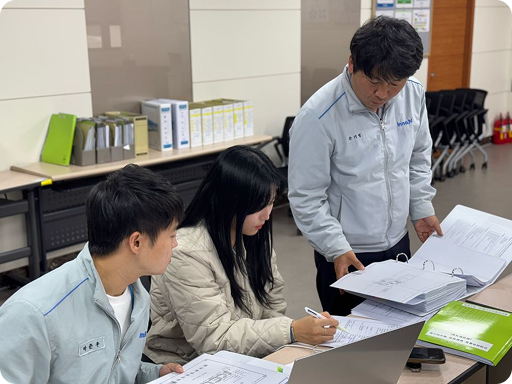
HK inno.N conducts regular audits on all of its manufacturing sites operated by HK inno.N, Osong, Daeso, and Icheon, to identify and manage risks caused by environmental impact twice a year, every June and November. Through cross-checks between business sites with external organizations and the internal audits, the company monitored compliance with laws and regulations, identified legal risks, and implemented corrective actions accordingly.
| Business Sites | Date of Environment Audit | |||
|---|---|---|---|---|
| 2024 First half year |
2024 Second half year |
2025 First half year |
2025 Second half year |
|
| Osong | 5/28 | 11/19 | 6/27, 6/30 | 11/12 |
| Daeso | 5/23 | 11/14 | 7/01, 07/2 | 11/11 |
| Icheon | 5/21 | 11/12 | 7/03, 7/04 | 11/13 |
Environmental improvement requirements for partner companies
HK inno.N conducts a risk diagnosis and assessment on partner companies annually to identify any environment-related risks borne by partner companies. HK inno.N conducts a thorough review of partner companies' environmentally related business practices, such as environmental management systems, strategies, environmental impacts and pollutant emission monitoring, as well as their actual management performances.
If the risk diagnosis of supply chain indicates that basic standards are not met within the partner company, HK inno.N requests follow-up measures to be taken. An implementation report is submitted by the partner company for further monitoring. If risk management is insufficient or the risk is material, HK inno.N provides support on relevant issues. Environment-related support may provided in the form of in-person or online training, publication of newsletters and supply of training materials to help the partner company strengthen its capabilities for environmental management.
In 2024, training was conducted for partner companies as part of the quality meetings on the theme of ‘The Importance of Sustainable Supply Chain Management and Greenhouse Gas Emissions Management’. In 2025, HK inno.N has been providing technical support to establish an environmental management system at partner companies and to compile greenhouse gas emissions-related data within the supply chain. Such efforts are expected to continue by expanding the number of partner companies subject to audits and providing further support, in a bid to prevent risks within the value chain.
Environmental performance as a factor in executive compensation
HK inno.N has resolved through the Sustainability Management Committee to incorporate climate change and pollutant emission management performance into the KPI of the CEO and the management level. These KPIs are applied to the performance-based compensation of the management and the organization. Every year, the implementation of the carbon neutrality roadmap is set as a KPI of the CEO to ensure execution of environmental management. Additionally, key KPIs such as the reduction of air and water pollutant emissions and the improvement of waste recycling rates of each business site, are established to facilitate mitigation measures. The Safety Environment Committee (C-Level) supervises and monitors environmental management strategies and performances at least once every half-year, while the Sustainability Management Committee (B-Level) conducts report of climate change risk management status.
Under the Water Environment Conservation Act and the Clean Air Conservation Act, HK inno.N monitors the performance of the discharge of pollutants by Osong, Daeso and Icheon producing sites that are legally obligated to measure and publicly disclose the level of pollutants. The monthly performances of the sites are compiled once every quarter and reported to the Ministry of Environment once a year. The quantity of water pollutants (TOC and BOD) discharged by HK inno.N has been on the decrease in the last three years. In particular, the discharge of BOD decreased by approximately 48% from the 2022 levels. Other pollutants have shown some fluctuation depending on the annual operational days and manufacturing quantities. To strategically reduce pollutants, HK이노엔 has also installed ultra-low NOX burners and synchronized senior management’s KPI’s with performance on the reduction of quantities of pollutants discharged.
Air pollutant-related measures
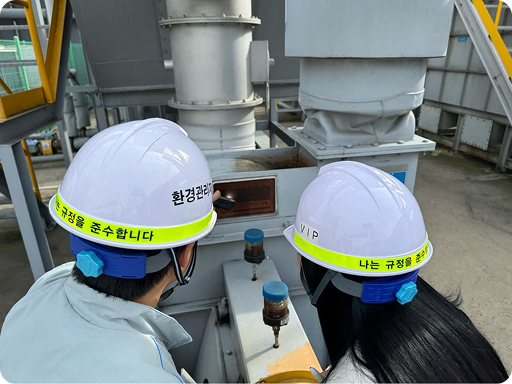
To reduce air pollutants, HK inno.N replaces activated charcoal in its equipment at a higher frequency than required under law. The company has also stipulated its internal guidelines on air environmental management to have a lower limit than that in the Clean Air Conservation Act by 70%. The relevant targets and performance compared against the target are incorporated when evaluating senior management on their KPI’s.
Burners are also in the process of being replaced by the ultra-low NOx versions that are known to emit less NOx but operate at higher efficiency. In 2023, the two boilers at the Daeso Plant have been replaced to ultra-low NOx versions, with an additional burner being replaced during the first half of 2025. During the second half of 2025, the dilapidated boilers at the Icheon Plant will be replaced with new ones that have better efficiency in reducing air pollutants. The company plans to consider environmental impact when making decisions on investments and increase the share of ultra-low NOX burners as part of the plan.
Water pollutant-related measures
HK inno.N’s plants in Osong, Daeso and Icheon have their own wastewater treatment facility that ensures appropriate and legally compliant steps are taken for wastewater discharge. The Icheon plant, however stands out for its particularly strict standards for wastewater discharge as once the wastewater is treated on site, it is directly discharged into the streams. This is unlike the plants at Osong and Daeso where the wastewater goes through an additional step at the public water treatment facility before being let out.
As such, the services of an external vendor specializing in pollutant measurement had been used on a bi-weekly basis for the monitoring of pollutants in the discharged wastewater. Since 2024, the monitoring has been done by in-house personnel on a weekly basis. All plants of HK inno.N have a water quality management policy of applying stricter internal standards than what is required under the Water Environment Conservation Act (i.e. at 10% of the legally required limit). Performance against this standard is also synchronized with the KPIs of senior executives.
Chemical substance and hazardous chemical substance-related measures
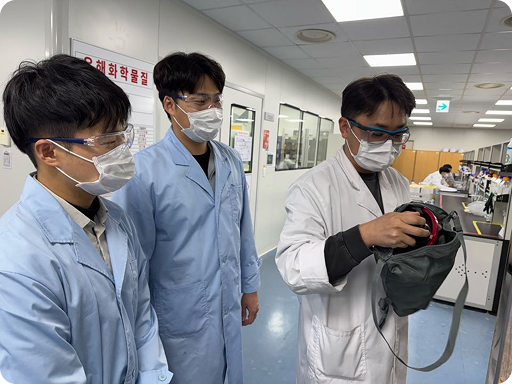
HK inno.N, based on the internal guidelines on the control of hazardous chemical substances, have put in place measures to be taken under relevant laws including the Chemical Substances Management Act, and manages and supervises chemical substances throughout all processes accordingly. The Safety Environment Team that is in charge of granting approval for the use of hazardous chemical substances, ensures that inspections by independent bodies are also carried out in accordance with the legally required frequencies. Meanwhile, the front-line employees apply a checklist to conduct weekly self-inspections against the legal standards and limits. The inspection results are logged and recorded.
Employees that handle hazardous chemical substances are required to undergo regular training to remain compliant with relevant regulations. The Daeso Plant has been appointed ‘Corporation Participating in the Initiative to Promote Chemical Safety in Chungbuk Communities’ and as such, is expected to carry out various collaborative activities with government bodies related to the Chemical Substances Management Act until year 2026.
Measures for the replacement and minimized use of hazardous substances
HK inno.N strictly restricts the use of chemicals prohibited according to the Chemical Control Act and monitors the use of hazardous chemicals. However, due to the characteristic of the pharmaceutical industry, it is necessary to comply with the manufacturing environmental conditions, material usage, cleaning cycles and methods as stipulated by SOP, which presents several challenges of substituting and reducing hazardous chemicals. Nevertheless, efforts are being made to reduce hazardous chemicals in processes not regulated by SOP and in ways which do not affect the processes.
As part of these efforts, the hazardous chemical 'sodium hydroxide,' previously used for pH neutralization during wastewater treatment, has been replaced with the non-hazardous chemical 'sodium aluminate.' Additionally, the acidic chemical 'hydrochloric acid (H+)' has been replaced with 'sulfuric acid (2H+),' which achieves greater efficiency with smaller quantities. Although both substances are classified as hazardous chemicals and subject to the same regulatory conditions, the improved neutralization speed and efficiency are expected to result in a reduction of chemical usage.
*SOP: Standard Operating Procedure
Targets related to pollution
1) ton/KRW 100 billion
HK inno.N has been annually replacing burners with ultra-low NOx burners to reduce air pollutant emissions, which has successfully lowered the concentration of nitrogen oxides emissions. However, due to an increase of operating days and hours, the total amount of air pollutant emissions increased in 2023 compared to the baseline year.
Additionally, to reduce water pollutant emissions, a final discharge filter was installed, which decreased the concentration of suspended solids (SS), resulting in a reduction of the water pollutant emissions in 2023 compared to the baseline year.